Joint pain can make everyday activities harder than they should be. You might notice knee pain when climbing stairs, shoulder discomfort during exercise, or stiffness that keeps returning despite previous treatments. If you’re looking for an option beyond temporary pain relief, PRP joint therapy may be worth considering.
Platelet-rich plasma (PRP) therapy uses concentrated platelets from your own blood to support your body’s natural healing processes. This non-surgical treatment may help reduce pain and improve function in certain joint and soft tissue conditions.
A naturopathic doctor with musculoskeletal expertise can help you understand how PRP works, its potential benefits, and when it may be appropriate for your joint condition.
PRP therapy concentrates platelets and the growth factors they release before delivering them to an affected joint or soft tissue. Think of it like bringing extra repair supplies to a damaged area of your home. The materials support the work, but the outcome depends on how much damage exists and how your body responds.
Similarly, PRP provides growth factors involved in the tissue repair process, although research has not established that it reliably regenerates damaged tissue.
Your blood contains platelets that help stop bleeding and release growth factors involved in tissue repair. These proteins influence how cells respond to injury and participate in processes such as collagen production and blood vessel formation.
Several growth factors contribute to this process.
In practical terms, these growth factors are part of the same process your body uses when healing a cut or a bruise, but concentrated and delivered directly to a joint or tendon that isn’t healing well on its own.
A medical professional takes a small blood sample and separates the platelets for injection. These platelets support the tissue repair process, but PRP cannot guarantee that damaged cartilage or tendons will grow back.
PRP is an autologous treatment, meaning it uses material collected from your own body rather than donor tissue. Because the plasma comes from your own blood draw, your body recognizes its components. This reduces the risk of immune reactions that can occur with donor tissue or synthetic materials.
This approach also aligns with naturopathic medicine, which emphasizes working with the patient’s own biological resources.
However, using your own blood does not make PRP risk-free. Proper preparation, medical screening, and sterile injection techniques remain important for your safety.
Researchers have studied PRP for several musculoskeletal conditions, including osteoarthritis, tendon injuries, and certain ligament problems. The available evidence differs considerably between these conditions.
Researchers have studied PRP most extensively for knee osteoarthritis, a condition where the protective cartilage that cushions the ends of your bones wears down over time. Most of this research involves mild-to-moderate cases. Some studies report improvements in pain and function, but clinical findings remain inconsistent. A patient with mild knee osteoarthritis who struggles to walk comfortably for more than 20 minutes might notice that distance increasing after treatment, while someone with advanced cartilage loss in the same joint may see little change.
PRP may also offer benefits for hip and shoulder osteoarthritis, although research remains more limited. Advanced cartilage loss can further reduce the likelihood of meaningful improvement.
Discover personalized health insights and connect with Dr. Chad Larson for a comprehensive approach to wellness that addresses the root causes of your health concerns.
Tendon injuries can cause persistent discomfort, especially when repetitive movements prevent the affected tissue from recovering. Researchers have investigated PRP for several conditions, including:
Some ligament injuries leave you with ongoing soreness or joint instability even after rest and physical therapy. PRP therapy has been studied for conditions such as chronic ankle sprains and certain ligament injuries, although evidence for these uses remains limited.
In some cases, your doctor may also discuss prolotherapy, another regenerative injection treatment that uses an injected solution to stimulate a localized tissue response.
PRP therapy cannot address every type of joint damage. Certain conditions may require different treatments or further medical evaluation.
LEARN MORE: Top Natural Therapies Used by Solana Beach Naturopathic Doctors
If joint pain keeps returning, you may wonder if another injection, surgery or simply giving your body more time will help. Each option has different benefits and limitations, and the right choice depends on your diagnosis, symptom severity and treatment goals.
Here’s how the options compare.
| Option | How It Works | Recovery Time | Main Limitation |
| PRP therapy | Uses concentrated platelets to influence tissue repair processes | Usually a few days of activity modification | Benefits vary by condition and may take weeks to develop |
| Cortisone injections | Reduces inflammation and pain | Usually minimal downtime | Relief may be temporary, and repeated injections carry risks |
| Joint surgery | Repairs or replaces damaged joint structures | Weeks to months, depending on the procedure | Surgical risks and longer rehabilitation |
| Observation and conservative management | Uses monitoring, activity changes, and appropriate non-surgical treatments | Depends on the treatment and condition | Some injuries may persist or worsen without further intervention |
You may benefit from exploring PRP if your joint pain continues despite physical therapy, activity changes, or other conservative chronic pain treatment.
Discover personalized health insights and connect with Dr. Chad Larson for a comprehensive approach to wellness that addresses the root causes of your health concerns.
PRP isn’t a logical next step just because cortisone wore off or physical therapy plateaued. Exercise-based rehabilitation, appropriate medications and changes to how you load the joint during daily activities still resolve many cases without injections.
For some patients, PRP may be worth discussing when these measures have not provided sufficient relief, and the available evidence supports its use for their condition.
Cortisone injections (also called corticosteroid injections) can help manage painful inflammation and may provide useful short-term relief. However, repeated use deserves careful consideration.
A 2017 study published in JAMA found that patients who received knee corticosteroid injections every 3 months for 2 years experienced greater cartilage loss than those who received saline injections. The study also found no significant difference in pain improvement between the groups.
These findings raise concerns about that repeated injection schedule, although they do not mean every cortisone injection damages your joints.
Corticosteroids still have a role in managing certain joint conditions. The decision should account for how often you need injections, how long relief lasts, and the risks of continued treatment.
Research on PRP therapy shows potential benefits, but results are not consistent across studies.
Differences in platelet concentration, preparation methods, injection schedules, and patient characteristics may help explain why studies report different outcomes.
Another important distinction is the difference between symptom relief and structural repair. An improvement in pain does not necessarily mean PRP has rebuilt damaged cartilage.
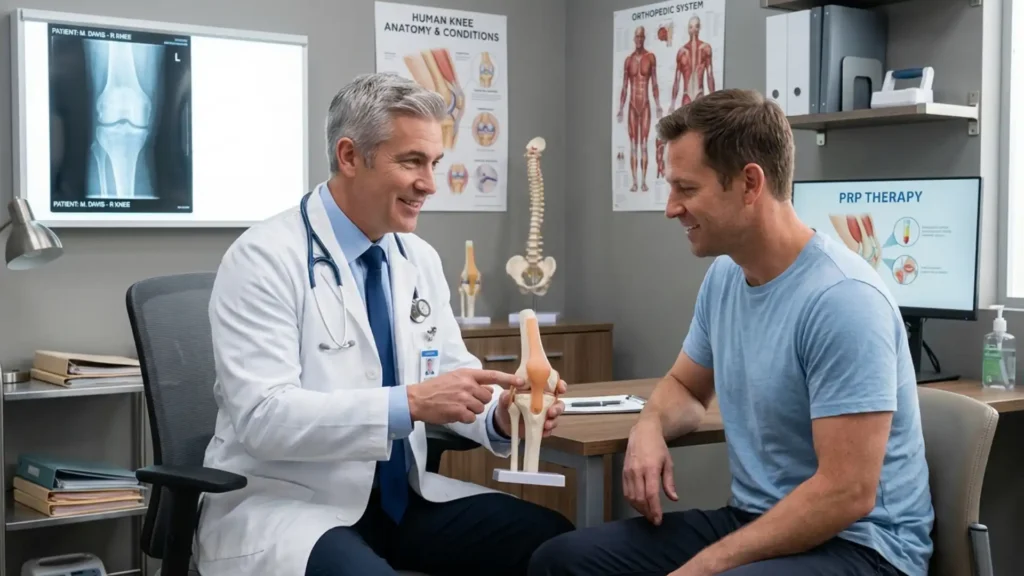
PRP treatment involves several steps, from evaluating your joint to preparing the platelet-rich plasma and performing the injection.
Your initial consultation with a naturopathic doctor includes a review of your medical history, current symptoms, previous treatments, and relevant imaging results.
Your doctor may also assess your joint movement, strength and stability to better understand what’s causing your discomfort. Your goals matter, too. You may want to return to running or play pickleball without shoulder pain.
If you’re looking for a naturopathic doctor for joint pain, look beyond general wellness services. Relevant musculoskeletal training, injection experience, and the ability to recognize when an orthopedic referral is needed are important qualifications.
Unlike an unlicensed naturopath, a California-licensed naturopathic doctor has completed the professional education and licensing requirements necessary to practice within the state’s defined medical scope.
If PRP is appropriate for your condition, your doctor draws a small sample of blood from your arm, similar to a routine blood test.
A centrifuge, a machine that spins your blood sample at high speed, then separates its components and concentrates the platelets. This process produces platelet-rich plasma that your doctor prepares for injection.
Your doctor injects the prepared PRP into the affected joint, tendon or ligament using anatomical guidance and appropriate injection techniques.
Discover personalized health insights and connect with Dr. Chad Larson for a comprehensive approach to wellness that addresses the root causes of your health concerns.
PRP joint therapy generally takes place in an outpatient setting without surgical incisions, general anesthesia or a hospital stay.
You may feel temporary pressure or discomfort during the injection. Most patients describe it as brief pressure with a dull ache that lasts a few seconds, not the sharp pain they expected.
PRP treatment schedules vary because different joint and tendon conditions require different approaches.
At The Adapt Lab, a typical PRP series involves 4 to 6 sessions spaced approximately 2 to 3 weeks apart. Your clinical team will clarify the recommended schedule for your specific treatment.
Your treatment plan may include:
This schedule reflects The Adapt Lab’s approach, not a universal PRP requirement.
PRP addresses the injury site, but it doesn’t strengthen the muscles around the joint, correct the movement pattern that caused the problem, or change the metabolic factors that may be slowing your recovery. Addressing these factors can complement PRP treatment and help manage recurring discomfort.
At The Adapt Lab, your recovery strategy may include:
Metabolic health can also influence your joints. Research links osteoarthritis with excess body weight, chronic inflammation and insulin resistance, a condition where your cells don’t respond efficiently to insulin.
When your medical history suggests metabolic concerns, additional testing may offer useful information. Relevant markers include:
These measurements may help guide nutrition, weight management, and broader metabolic health strategies. However, they do not predict PRP treatment success, and improving them has not been proven to increase PRP effectiveness.
READ MORE: What Is a Naturopathic Doctor? A Guide for San Diego Residents
Recovery after PRP joint therapy involves an initial period of injection-related discomfort followed by a longer period during which you can assess changes in your symptoms and physical function.
You may experience mild soreness, swelling or stiffness around the injection site during the first few days. Some patients also notice a temporary increase in pain as their body responds to the injection.
These symptoms typically improve within several days, but they do not necessarily indicate that tissue repair has begun.
Your doctor will provide specific aftercare instructions, including activity restrictions and pain management recommendations. Certain anti-inflammatory medications, such as ibuprofen and naproxen, may interfere with platelet activity, so your doctor may recommend avoiding them for a period of time.
Do not stop prescribed medications, including aspirin or blood thinners, without discussing the change with the clinician who manages them.
You may resume light daily activities relatively soon, but strenuous exercise, heavy lifting and high-impact sports may require a longer break. Your instructions will depend on the injection site and the condition being treated.
Discover personalized health insights and connect with Dr. Chad Larson for a comprehensive approach to wellness that addresses the root causes of your health concerns.
PRP injections carry potential risks, including infection, bleeding, temporary discomfort and injury to nearby tissues.
Before treatment, your doctor should review your medical history, medications and any conditions that may affect platelet function or blood clotting.
Proper screening, sterile injection techniques and appropriate follow-up help reduce complications.
Seek prompt medical attention if you develop fever, worsening redness, severe swelling or increasing pain after your injection.
Some patients notice changes within several weeks, but meaningful symptom improvement may take a few months. Responses vary, and some patients experience little or no benefit.
You can assess your progress through several practical measures.
These measurements provide a clearer picture of your response than relying on pain relief alone. They can also help identify when a different treatment strategy deserves consideration.
PRP joint therapy offers a potential option for certain joint and tendon conditions, although research does not show consistent benefits for everyone. Understanding your diagnosis, the available evidence, and the limitations of each treatment can help you make a more informed decision.
At The Adapt Lab, Dr. Chad Larson, a board-certified naturopathic doctor and chiropractor, combines musculoskeletal expertise with a focus on metabolic health. His Metabolic Magic Method uses advanced diagnostic testing when clinically appropriate to assess factors such as inflammation and metabolic dysfunction.
If persistent joint pain has you considering PRP, a professional assessment can help clarify your options. Book a consultation at The Adapt Lab in Solana Beach to discuss your symptoms and determine if PRP therapy is appropriate for you.

Joint pain can make everyday activities harder than they should be. You mig...
Read MoreYou get a full night’s sleep but still wake up exhausted. Your periods be...
Read MoreYou eat well, exercise regularly and still struggle to lose weight. By mida...
Read MoreIntegrative health care in North County San Diego is a clinical model led b...
Read More