You get your lab results back, scan the page, and notice something unfamiliar: HOMA-IR. It’s not a number most people recognize, yet it offers a clear look at how your body is handling insulin behind the scenes. Unlike a basic glucose test, HOMA-IR can reveal early shifts in metabolic function before they show up in more obvious ways.
If your number is higher than expected, it points to insulin resistance, one of the key drivers of metabolic dysfunction. That affects more than blood sugar. It influences energy levels, fat storage, and how your body responds to food over time. This blog breaks down what HOMA-IR measures, how to read your results, and what a high score actually means for your long-term metabolic health.
HOMA-IR stands for Homeostatic Model Assessment of Insulin Resistance. The name sounds technical, but the idea is simple: it shows how well your body responds to insulin, the hormone that moves glucose out of your bloodstream and into your cells.
Think of insulin like a key and your cells like locked doors. When everything works well, that key opens the door easily, and glucose moves into your cells without resistance. Over time, those “locks” can become harder to open. Your body responds by sending more keys (more insulin) to force the same result. HOMA-IR reflects how much effort your body needs to keep that process going.
Your HOMA-IR score comes from two fasting lab values: insulin, measured in µU/mL (micro-units per milliliter, a standard unit for measuring hormone concentration in blood), and glucose, measured in mg/dL (milligrams per deciliter, which tells you how much sugar is present in a given volume of blood). The calculation is:
HOMA-IR = (fasting insulin × fasting glucose) ÷ 405
To give that formula some grounding: a fasting insulin of 5 µU/mL and a fasting glucose of 85 mg/dL produces a HOMA-IR score of roughly 1.05, which falls in the normal range. Raise that insulin to 18 µU/mL with the same glucose level, and the score climbs to 3.78, well into significant insulin resistance. As a quick reference, a score under 1.0 is considered optimal, and anything above 1.9 starts to signal insulin resistance. The full breakdown follows below.
The 405 divisor applies when glucose is measured in mg/dL, which is standard in the United States. If your lab uses mmol/L instead, the formula uses 22.5.
Looking at insulin and glucose together gives a clearer picture. Your glucose might look normal on its own, but if your insulin is high, it can show that your body is already working harder than it should. HOMA-IR brings these two numbers together to show how well your body is managing blood sugar at baseline.
READ MORE: What to Expect at Your First Metabolic Health Consultation
The test itself is simple. It uses blood from a standard fasting panel, the same one ordered for cholesterol or blood sugar. No special equipment, no extra steps. Once your fasting insulin and glucose are measured, most labs calculate your HOMA-IR automatically. It’s a small addition to your labs, but it gives a considerably clearer view of your metabolic function.
To get an accurate result, you need to fast for 8 to 12 hours before your blood draw. Water is fine. Food, coffee, and most supplements can interfere with your numbers.
Two factors that quietly skew results:
If you want a result that reflects your true metabolic state, keep things consistent and low-stress leading into your test.
ALSO READ: What Blood Tests Are Included in Metabolic Health Screening?
This is usually the first place you look, and for good reason. You have a number, and you want to know what it says about your insulin sensitivity.
Discover personalized health insights and connect with Dr. Chad Larson for a comprehensive approach to wellness that addresses the root causes of your health concerns.
Here are the commonly accepted clinical ranges, along with what each one means for your body:
These ranges are not a simple pass-or-fail. A score of 2.1 and a score of 4.8 both fall into insulin resistance territory, but they reflect very different levels of strain. Your full picture matters: how you feel, what your other labs show, and how long this pattern has been in place.
Tracking your results at consistent intervals gives you direction, not just a data point. You start to see if your insulin sensitivity is improving, holding steady, or declining over time.
Your HOMA-IR can shift based on factors that affect insulin and glucose in the short term. Poor sleep, acute illness, high stress, and recent changes in body composition can all push your number up temporarily.
If your result lands in a borderline range around 1.9 to 2.5, repeat your metabolic screening test under consistent conditions before drawing conclusions. When the pattern repeats, it carries weight. If it doesn’t, then context, like disrupted sleep or recent illness, likely influenced the initial result.
If you want a second layer of validation, your naturopathic doctor may look at QUICKI (Quantitative Insulin Sensitivity Check Index). It uses the same fasting values to calculate insulin sensitivity from a different angle, which can help clarify results that sit in a gray area.
RELATED ARTICLE: How Biomarker Testing Can Reveal Hidden Health Issues
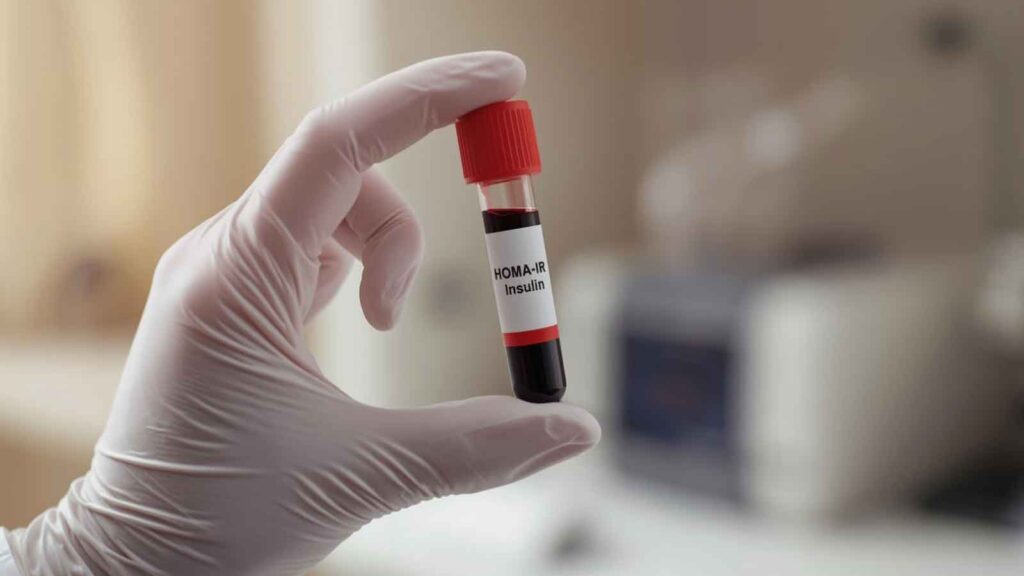
So what does it really mean when your number is high? When your HOMA-IR rises above the normal range, it points to a pattern of insulin resistance that can affect far more than blood sugar alone. You may notice changes in energy, cravings, body composition, or how steady you feel after meals. A higher score shows that glucose regulation is starting to drift, even if more familiar markers have not raised concern yet.
This can go on for years without obvious signs. By the time glucose or A1C, your average blood sugar over the past two to three months, starts to rise, the pattern has often been in place for a while. That’s why catching it early matters. It gives you a chance to address the problem when there is still more room to change the trajectory.
An elevated HOMA-IR connects to several well-established metabolic conditions:
Picture two people with the same fasting glucose: 88 mg/dL. On a standard panel, they look identical. But one maintains that number with a fasting insulin of 4 µU/mL, reflecting efficient metabolic health and responsive cells.
Discover personalized health insights and connect with Dr. Chad Larson for a comprehensive approach to wellness that addresses the root causes of your health concerns.
The other requires a fasting insulin of 22 µU/mL to hold the same glucose level, a clear sign of compensation and cellular resistance. Standard panels don’t surface that difference. A metabolic screening test that includes HOMA-IR does.
HOMA-IR responds to change, often faster than expected. With consistent inputs, you may see measurable shifts within weeks. Sustained improvement takes longer and comes from addressing the underlying drivers rather than targeting the score itself.
The strategies with the strongest clinical backing:
Soluble fiber can support this process by slowing glucose absorption after meals, which helps reduce the insulin response.
You can clean up your diet, stay consistent with exercise, and still see your HOMA-IR stay elevated. That doesn’t mean you’re doing something wrong. In many cases, it points to deeper issues, like hormone imbalances, thyroid dysfunction, or more established insulin resistance that doesn’t shift with lifestyle changes alone.
This is where a more structured evaluation becomes useful. Advanced metabolic testing identifies the specific drivers behind your results. Targeted treatments, including GLP-1 therapies like semaglutide and tirzepatide, work directly on insulin signaling pathways and have shown meaningful HOMA-IR reductions in clinical trials.
When integrated into a complete medical weight loss program, they function as evidence-supported tools that support the process, not replacements for the foundational work.
Your HOMA-IR gives you a clearer view of how your metabolism is functioning beneath the surface. It helps explain patterns like low energy, stubborn weight, or unstable blood sugar. Once you know your number, you’re no longer guessing. You’re working with real data that shows where your metabolic health stands today.
If you haven’t tested it yet, you can request it with your next fasting panel by adding fasting insulin to your standard glucose labs. If you already have a result that raises questions, a more complete metabolic screening puts HOMA-IR in context alongside hormone levels, inflammatory markers, and other key indicators to give you a clearer direction forward.
Dr. Chad Larson uses HOMA-IR as part of a comprehensive metabolic testing process in Solana Beach. Rather than looking at a single number in isolation, he evaluates your results alongside other key health markers to better understand what may be affecting your metabolism. If your HOMA-IR is elevated or you want a clearer baseline, schedule a consultation for a more complete assessment of your metabolic health.

Integrative health care in North County San Diego is a clinical model led b...
Read MoreYou've counted calories, stayed consistent in the gym, and cleaned up your ...
Read MoreChronic stress shows up in your lab work through disrupted cortisol pattern...
Read MoreGLP-1 medications didn’t stay under the radar for long. If you’re in En...
Read More